
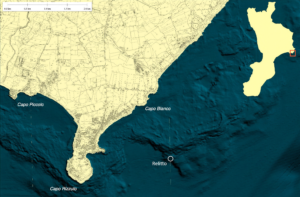
The wreck of the Bengala, one of the largest and most modern steamships of the 19th century, lies about 1,500 m offshore from Isola Capo Rizzuto, within the Marine Protected Area of the same name.
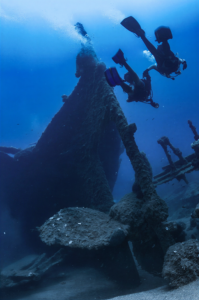
This giant rests on a sandy seabed at a depth of 26–29 m and hosts such a variety of marine flora and fauna that it is considered an important site of both biological and archaeological interest.
The wreck is 75 m long and 9.5 m wide and remains in good condition, despite the collapse of the main deck and hull sides caused by blast fishing after the sinking. The mainmast was removed in recent years, as it protruded above the water and posed a hazard to navigation.
The best-preserved section of the wreck is the hull, along with parts of the hold. On the main deck, a pulley with an arm and some winches used to handle cargo and lifeboats are still visible. The stern is also well preserved, with its large three-bladed propeller still in place. The engine and boiler compartment is clearly visible in the uppermost part of the wreck, which has lost its masts and funnel. At the bow, the two large anchors and their chains remain in place.
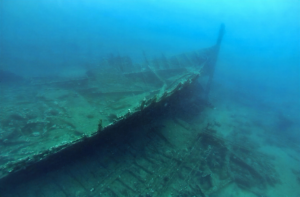
Bengala was not the ship’s original name. Built in England, it was launched in 1871 as Mecca. It had ample cargo capacity and a registered tonnage of about 1,500 tons, features that placed it among the largest and most modern steamships of its time. Its “hybrid” propulsion system marked a major innovation in 19th-century marine engineering, combining steam with sails. Its function was also hybrid: the vessel was both a cargo ship and a luxury passenger vessel, with cabins accommodating nearly 300 passengers across first, second and third class.
For about a year, the ship sailed between England, India and Italy. It later passed into Italian ownership and was renamed Bengala, sailing from Italy to the United States, Latin America, and as far as Singapore. In the spring of 1889, while en route from Taranto to Catanzaro Marina, it struck the rocky shoals off Capo Rizzuto. A large breach opened in the hull, and the giant sank.
