
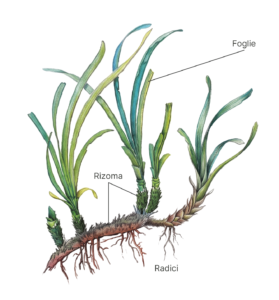
Posidonia oceanica is a seagrass endemic to the Mediterranean, descended from terrestrial plants that adapted to life at sea. It is a vascular plant with roots, stems, leaves, flowers and fruits.
Its ribbon-like leaves grow in bundles from a modified stem called the rhizome.
The roots anchor the plant to the seabed, while the rhizomes grow horizontally to spread the meadow or vertically to counter sediment accumulation.
Posidonia meadows are complex, biodiverse ecosystems, with food webs involving herbivores, predators and decomposers. Their structure provides shelter, food and nursery grounds for many marine species.
Interwoven rhizomes, roots and sediment form the matte, a biogenic reef that stores organic carbon over long periods, helping to mitigate climate change. The meadows also oxygenate the water, stabilise the seabed and protect coasts from erosion.
Their conservation status is an indicator of environmental quality and helps guide the planning of marine protected areas. They are recognised as a priority habitat (1120*) under Directive 92/43/EEC.
