
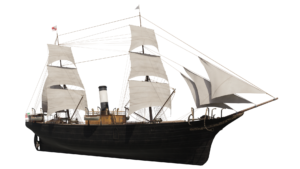
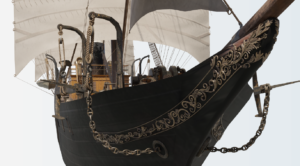
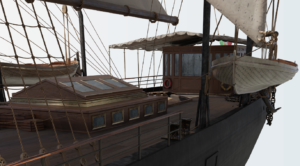
Figs. 1–3: Hypothetical reconstruction of the ship: side view, bow view, and stern view from the lifeboat side.
The model on display in front of you was 3D-printed using data from a 3D photogrammetric survey carried out by divers at the actual wreck site.
The survey was then used to develop a hypothetical reconstruction of what the steamship may have looked like before it sank, since no photographs or drawings of the vessel from that period are known.
The reconstruction was developed in close collaboration with archaeologists and other specialists. It also drew on design plans, maps, reference images and historical sources to depict the Bengala as accurately as possible.
Work began with a 3D model of the hull, whose dimensions, proportions and shape were derived from the photogrammetric model, as were details such as the railings, anchors, pulley and propeller.
To reconstruct the sails, rigging and masts, none of which survive on the actual wreck, we drew largely on photographs of vessels from the same period and on advice from archaeologists.
The cabins and funnel, by contrast, required a mixed approach: some features were preserved and still visible in the 3D model, but there was not enough detail to reconstruct them without other references.
Once the modelling phase was complete, colour was added to the 3D model by applying textures that reproduce the likely appearance of the materials from which the ship was made. This stage also required studying other vessels from the same period and consulting experts throughout.
Thanks to augmented reality (AR), you can now explore the ship as if it were right in front of you.
